
The Tempest by Brian Beck

I had no more than finished typing the last sentence of "Have You Ever Seen the Rain" when I heard the sizzle of raindrops on my campfire.  It caught me off guard.  We had explored Mesa Verde all day and while there were some dark clouds to the south of us, they were at least 100 miles away.  At eighty-five hundred feet, Mesa Verde has a commanding view of the surrounding desert three thousand feet below.  It's perfect for checking out the weather (or for spotting the enemy Navajo if you're an ancient Anasazi).  The summit of Mesa Verde serves as a fire lookout with a 160 mile, 360 degree view of the entire Four Corners region.  I checked the radar app on my phone several times throughout the day and it seemed to confirm my visual analysis:  the storms were headed well south of us. 

I was wrong.  About 11pm, the first flashbulbs of lightning lit up the night sky.  They lacked the telltale caboose of thunder so I assumed it might be the edge of one of the storms to the south.  As a precaution though, I closed up my computer and threw the kids' shoes inside the tent.  I put my computer and camera in the trunk of the car, threw another log on the fire to combat the sprinkles and poured myself another scotch.  Time to sit back and watch the light show.

The rain came a little harder and just as I was thinking it might be time to retire, the sky lit up like daytime.  I counted... 1, 2, BOOOOOMMMMM.  About the same time that the thunder rattled my fillings, the heavens opened.  When you're sleeping in a tent, rain sucks.  I mean, it really, really sucks.  We have a good tent, not like the heavy, leaky army-style tents we used as kids that were more colander than canvas.  The modern ones repel water pretty well, but they are still designed more for the sprinkle than the flood.  And in a matter of seconds, it was about to flood.  The drops weren't falling, they were being driven to the ground as if from a meteorological machine gun.  I dove into the Pontiac just as another bolt of lightning struck up the hill from us, close enough to see the auxiliary flash where it hit the ground.  This time, the thunder caboose was attached to the engine.

Then the wind started.  I could feel the car starting to shake and through the wall of water that was now falling I could see the little tent quivering like an 80's break dancer between the strobes of lightning.  If the kids were awake (how could they not be), I couldn't just leave them there.  I mean, I could... it would be deserved payback for all the pinching and hitting the past several weeks.  What is the right price to pay for starting every single solitary sentence with "Daddy..." and ending it with "in the Clone Wars."  I mean, there has to be a cost for that, right?  The next crash of thunder brought me back to reality and I gritted my teeth, opened the door and ran for the tent.  I unzipped it and dove in, holding my soaked and muddy shoes in the air in a contorted yoga pose that I like to call "inverted armadillo."

Samantha was balled up in the corner of the tent and Parker lay motionless on his back, mouth open, looking like a dead trout.  With a tempest raging around them, they didn't move a muscle.  They were dead to the world.  I laid there in inverted armadillo thinking about how we were going to break camp in the morning and how everything would be covered with mud, which now included the inside of our tent.  If it had waited just one more day, just one more, we would have escaped three weeks camping in the West without getting wet.  If it let up by daybreak, by the time we dealt with all the wet gear we'd probably get out around 11am, which would get us into Las Vegas about twelve hours later at best. I thought about how I would tell this story and then suddenly realized I should be documenting this!  As the storm wound down, I got out my phone and managed to get a little bit of video.  And later, with the last few drops of rain tapping on the tent, I emerged, dashed to the car and set up my camera to see if I could get a killer shot of the lightning receding over the mesa.  I made the necessary adjustments, popped the shutter open and waited, listening to the other campers crawling out of their tents with nervous laughter and more than a few four letter words.  10, 15, 20 seconds.  Click.  Try again.  10, 15, 20 seconds.  Click.  Too late.  Like the Anasazi, the storm had vanished.  
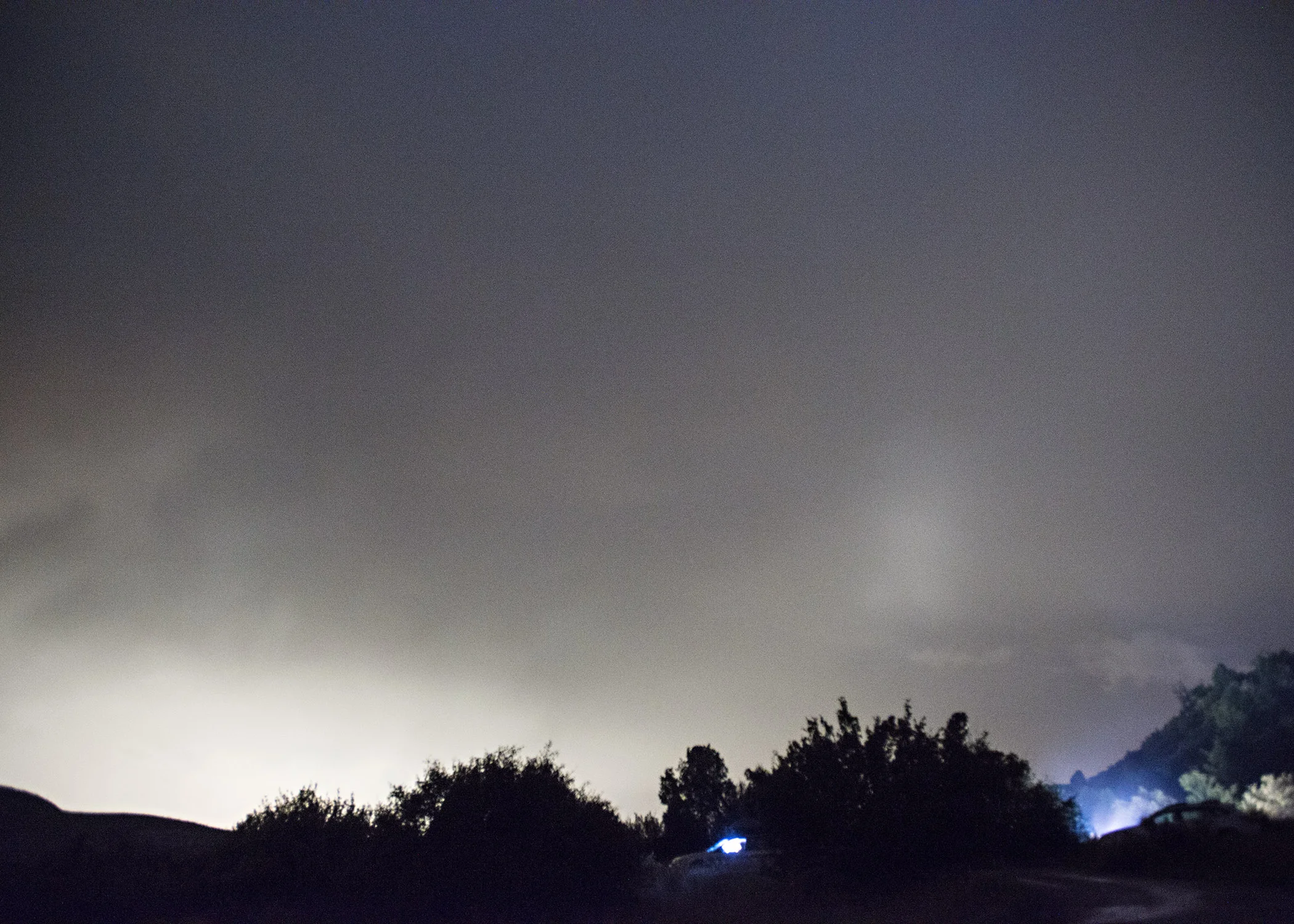
Outtake.  I opened the shutter about 30 seconds too late.  The last crack of lightning happened just as I put the camera on the tripod.  I set up the composition and fired off a few frames but the subject failed to appear.  You c…

Outtake.  I opened the shutter about 30 seconds too late.  The last crack of lightning happened just as I put the camera on the tripod.  I set up the composition and fired off a few frames but the subject failed to appear.  You can't win them all.  Nikon D800, 17-35mm lens @ 19mm, f 3.2, iso 2500, 15 seconds.

Canyon Palace at Mesa Verde National Park. Nikon D800, 24-120mm lens at 24mm, iso 100, f8, 1/200th sec.

Kids climb the narrow steps out of Canyon Palace, Mesa Verde National Park.  Nikon D800, 24-120mm lens @ 46mm. iso 100, f8, 1/100 sec.

Have You Ever Seen the Rain by Brian Beck

Quimby crept out of our hotel room in Rapid City two hours before sunrise and we awoke Monday morning feeling melancholy.  We had reached the northern apogee of our trip and with the car loaded and the oil topped off, we pointed the Pontiac south for the first time in two weeks to begin the long journey home.  As we rolled across the grasslands of the high plains, we met rain for the first time, building in the tall thunderheads and then unloading furiously like the tantrums of an angry and vengeful god.  We drove slowly south, back into Wyoming and then Colorado, reaching Denver and the front range of the Rockies as the sun slipped behind the peaks and the darkness closed in around our ship of chrome and steel.

We climbed into the mountains on US 285, a desolate stretch of highway that weaves its way through lesser-known ski towns proximate to Denver and then sinks back into rolling plains populated by little more than sage brush and steer.  I kept a watchful eye on the gas gauge as numerous stations were already dark, cognizant that the range of the old Pontiac is 200 miles on level ground and even less when climbing through the mountain passes.  Running under half a tank tempted fate.  I pulled into one station just as the lights were going out and with no fuel to be had, I took the the opportunity to change the kids into their pj's while a "closed" sign buzzed tauntingly from the office window.  Samantha climbed into the front seat and Parker flopped out on the twin-sized bench seat in back.  The gibbous moon rose early, and it turned the long stretches of pavement into a silver ribbon wrapping itself around hills and valleys like a gift from the night itself.  John Fogerty sang on the tinny dash speaker and underneath, the low rumble of the exhaust filled in the missing bass.  Samantha fell asleep beside me, head nestled in a pillow against the side glass, and in the moonlight and soft, warm glow of the dash lights, I wondered which of her memories from this trip would survive the ruthless filter of time. I know she won't remember many of the things that pulled the breath from my lips--the stillness of the frosty morning in Yellowstone, the wild horses galloping across the Black Hills, the Milky Way rising in a cauldron of black.  Maybe one day she'll discover the quiet grandeur hidden in those precious musical rests that punctuate the drone of everyday life.  I hope she does.  One has to listen.

I reached over to turn up the radio so I could join Mr. Fogerty.  "I wanna know o o, have you ever seen the rain?"  And then faintly from the other side of the seat Samantha's little voice perked up.  "Daddy, I've been listening to you sing," and then she chimed in, "Coming down, on a sunny day."

Milky Way over Mesa Verde National Park.  Nikon D800, 17-35mm lens, ISO 2500, f 2.8, 15 seconds

Setting up camp in Mesa Verde.  Nikon D800, 24-120mm lens, ISO 200 f8, 1/320 sec

Samantha having ice cream in Durango, Colorado.  Nikon D800, 24-120mm lens, ISO 160, f4.5, 1/160 sec. 

Stone Faces by Brian Beck

After a whistle stop at Devil's Tower, we pounded out the last hundred miles of our drive from Yellowstone to collect Quimby in Rapid City at 9:30pm on Friday night.  I raced against the clock all day, digging my heel into the floorboard to urge the old engine over the high mountain passes where the air is thin and the views go on forever. We had already booked two nights in Deadwood, so with the kids fast asleep, Quimby slid into the old Pontiac at the airport and we headed back north to Deadwood.

This part of the country has four major attractions: the triple mining towns of Deadwood, Sturgis and Lead, Mount Rushmore, Wall Drug and the Badlands.  They are all quick visits and we squeezed Deadwood and Rushmore into Saturday and then headed out on a wide loop on Sunday to take in Wall Drug and the Badlands.  Of all the stops, Rushmore was the most impressive.  It was intended as a monument to the ages symbolizing the American experience and I'm quite sure that long after our republic has been forgotten, future people will admire these faces that stare proudly across the hills of South Dakota.  

Only a few miles away though is Crazy Horse, a monument intended as a similar memorial to the Native Americans who were displaced by our westward expansion.  I saw this monument 33 years ago and sadly it seems no further along; apart from a face, it's a rough block of granite.  The contrast couldn't be more stark.  Forgotten and ignored, it seems to be the perfect embodiment of the grievances of the Native Americans.  Lest our indifference toward these people be similarly bequeathed to posterity, we owe it to them to finish the job.  

The Shots I Didn't Take by Brian Beck

The road trip rolled out of Yellowstone on Friday morning.  I had been telling the kids that Yellowstone is the crown jewel of America's national parks and with the skies overcast and the big animals somewhat sparse, the kids had tuned out the "whaa whaa" talker in the front seat.  The iPads seemed more interesting than the scenery.

All of that changed on Friday morning.  Storms had blown through overnight leaving the air crisp, if not downright cold, with a blanket of fog over the landscape.  After we coaxed the old car to life (cold and altitude aren't friends of a carburetor), we headed south out of Canyon toward the east entrance.  As we climbed the pass, the fog lifted slightly to reveal a light dusting of snow tucked into the rocks and crevices.  Bison are mentally unstable animals to begin with, and the notice from Old Man Winter that the summer rent was coming due had apparently put them in a vile mood. They stampeded down the road, charged at cars, and snorted at reckless tourists with cameras out the window.  I saw more than one car speed away with a bison galloping behind. Winter must exact an awful toll.

The photographs on that drive out of the park were everywhere and they were spectacular. It was a morning that would make an atheist grab a hymnal. As always seems to be the case though, we couldn't stay. Quimby was due to arrive in Rapid City at 9:30pm and that was 500 hard mountain miles away. I took as many shots as I could and then put the camera down and drove through a cathedral of stone and sky, reminding myself that of all the beautiful scenes I've photographed over the years, some of the greatest shots were the ones that I didn't take.  Those, I kept completely for myself.

The morning sky from the east side of Yellowstone Lake.

The fog lifts over a river in Yellowstone.

Bison look angrily through the trees on a late summer morning in Yellowstone.  Overnight snow put them in a foul mood.

Lucky Boy by Brian Beck

Quimby left our hotel room at 6am on Tuesday morning to catch a taxi to the airport, and shortly after she left we got up and cleared out. We made a run to Albertsons to refill our cooler for the stay in Yellowstone and headed north past the Tetons, now visible in their full glory with the smoke of numerous western wildfires blowing north on a better jet stream.

Yellowstone is only 50 miles north of Jackson Hole, but it was a full day's drive owing to the countless snarls of four-way flashers announcing close encounters with bears, bison, elk, moose and other wildlife common to these parts but exotic to the tourists (us included) migrating through their habitat. We arrived at dinner time, set up camp and roasted the obligatory hot dogs and marshmallows as the sun fell and the temperature dropped with it.

We got an early start on Wednesday and headed west to the geyser basin and Yellowstone's main attraction--Old Faithful. The drive and the many smaller pools, fumaroles and mud pots consumed much of the day and when the kids requested their iPads, I realized that they'd reached their limit, so we pulled into Canyon Lodge for a milkshake before heading back to our camp to make dinner.

Canyon Lodge is a large complex with a hotel, gas station, general store, several restaurants and gift shops surrounding an extremely large parking lot bordered by lodgepole pine forests. For those of you who, like me, have a vision of the national parks set somewhere in the second half of the last century, this is quite a surprise. I have to give them credit though--I think the national park service has realized that campers and their bacon breakfasts and sloppy fried chicken dinners are almost solely responsible for the numerous bears that have to be put down each year for doing what hungry bears do. If they can discourage it by instead luring the campers away from their tents with some mediocre gourmet food, everybody wins.

Now at this point in the post I have to confess that what I'm about to tell you is not my proudest moment. However, my friend Danielle told me she likes the fact that I'm reporting the bad along with the good and so, as your faithful reporter of this career sabbatical adventure, I feel duty-bound to tell you this: I lost my son today.

As soon as their milkshake straws sucked air, the kids ran off to the adjacent gift shop to look at bags of gemstones and miniature license plates. I settled the bill and caught up with them at a bin of polished rocks when a baseball cap embroidered with "Yellowstone" caught my eye in the next aisle. I adjusted the size, tried it on, found a mirror and was debating whether it made my already Leno-esque face look longer when Samantha grabbed my hand and asked me whether I would pay for postcards if she found some. "Yessss," I said, noting that this was probably the thousandth time on this trip they've asked me to buy them something.

Back to the hat, I decided it was a winner and went to round up the kids. Samantha was still perusing the postcards so I lit a fire under her and then went back to where Parker had been at the rocks. He wasn't there, so I circled the gift area, then went back to the soda fountain. Still nothing. I took a quick spin through the grocery area. No Parker.

Now, just to put this in perspective, I take some pride in being calm under pressure. Panic, I've come to realize, is almost always counterproductive. On the other hand, minutes had now passed and as I urgently swept the series of stores for the third time, conscious of the ticking clock, my stomach was falling. If this had been Samantha, I would have put all fears aside and thought logically. She would probably be in the bathroom or would find an employee or something similarly predictable. However, my kids couldn't be more different and I've always harbored a fear that in a stressful situation like this, Parker would be capable of any number of baffling decisions.

Not finding him in the store, I went outside and surveyed the parking lot. I have an eccentricity when it comes to parking my car, especially a classic, in that I like to park it as far away from the other cars as possible, even if that means a long walk. I could see my chrome tail lights some 200 yards across the busy parking lot and after searching the area through squinted eyes, I concluded that Parker wasn't there either. At a loss, I went back into the store. Samantha was circling calling his name and I told her to stay there, but my gut pulled me back outside. I asked an old man with a NPS uniform if he had seen a little boy about six years old come out of the store. "No," he replied.

Just then, a family sitting on a bench about 20 feet away who had overheard my question piped up. "I saw him," the Dad said. "He headed out into the parking lot a few minutes ago." My blood turned to ice water.

I broke into a full sprint across the parking lot towards the Pontiac rueing both my choice of parking location and my purchase of cowboy boots in Jackson Hole as I realized for the first time that they make truly shitty running shoes. I urgently called his name and scanned the rows of parked cars for any sign of his little wandering figure. As the car grew closer I could see that he wasn't there and I began to wonder whether he had attempted to find his way back to our campsite another 1/2 mile up the road or if he could have even remembered where our car was parked. If he had indeed made it this far, his next move would have been anyone's guess. As I reached the car, he was nowhere to be seen and my heart practically exploded in my chest. Still calling his name, I turned to survey the rest of the lot, completing a 360 degree turn and then wheeled back to the car in time to see Parker emerge from the opposite side with a look of shock on his dirty face. He held his stoic countenance for a few seconds and as I fell to my knees in front of him, he shattered into sobs.

I scooped him up and carried him back across the lot to where the old man and the family had gathered in front of the general store, refraining from any interrogation about how his face had gotten so dirty or why he had returned to the car; we've prepped the kids many times that if they lose us, the drill is to stay put. I thanked the small crowd for the clue that had helped end this ordeal before it became a full-fledged emergency and as the people dispersed, the old timer leaned in. "You gave your Daddy an awful scare," he said as Parker buried his face into my shoulder.  "Last week we had a little boy wander off in this parking lot and we had everyone out here in a line looking for the little feller. There's bears and bison that wander across here from time to time and we finally found him over in those woods. You're a pretty lucky little boy." He gave a crusty chuckle and then looked at me with a wry smile. "You look like you could use a drink."
 

Ezekiel's Valley by Brian Beck

It was the late summer of 1997, I had just taken the bar exam and I had packed nearly everything I owned into my little white 1992 Honda Civic.  I pulled out of my sister's driveway in Newton, MA and headed west.  I had no plan, no itinerary, no company.  It was just me and the road and I was running.  

I had separated from my first wife in the last few weeks of law school, a public and painful process that left me bruised, angry and feeling more than a little isolated.  She had been a large part of the reason I went to law school and our dissolution raised profound questions for me about whether the trajectory of my new career and the job that waited for me in Los Angeles were the right ones. So when I hit the road that August, my tentative destination was California but it wasn't set in stone.  Everything was up for grabs, everything was negotiable in the heart-to-heart conversation I was about to have with myself on the two-lane roads of America.

I wandered for awhile, but eventually wound up in Jackson Hole.  I thought I might do some backcountry hiking so I had purchased some basic gear at LL Bean in Freeport before I headed west.  This seemed like as good a place as any to give it a shot, so I stopped into the ranger station in Teton National Park and asked if they could recommend a hike that could take me well into the mountains for a 3 or 4 night stay.  The ranger drew some lines on the map in yellow highlighter and I picked one, drove to the trailhead and started hiking.

I hiked all day on a trail through a canyon that eventually broke into the high country just below the treeline.  I set up my camp on a beautiful outcrop of rock that overlooked a 1,000 foot drop to a small river with a gorgeous view of the opposite side of the canyon.  I stayed for three days and spent most of the time trying to figure out what I was going to do next.  I looked across that canyon with the proverbial angel on my shoulder and considered it all.  As the wind blew down that mountain, I decided to go forward, go to California and create a life out of what seemed to be a valley of dry bones.

I've reimagined those three days on the mountain in the Tetons many times.  I've looked for that spot on Google Earth and as time has erased the certainty of exactly where the spot was, its significance has only grown.  I've always known I would visit that spot again someday, and on this trip, with the future once again cloudy, the time seemed right.  So on Sunday afternoon, Quimby and I and the kids set off up the mountain in search of a spot now more imagined than real.

I made an educated guess that the place was Granite Canyon mostly because it looked right on the map.  I remembered the lake at the top after the trees fell away and the map showed a little blue dot called Marion Lake.  I recalled it being a strenuous hike but I attributed much of that to the gear I was carrying that day 18 years ago.  But sure enough, after the first two miles, the trail curved to the left into the canyon and started a serious climb.  As we walked, enough views looked familiar that I knew we were on the right trail but the kids were beginning to tire and it was already a five mile round trip for them, so Quimby agreed to play with them in the river while I forged ahead in search of my dream.  

Freed from the pace of the kids, I ran up that mountain.  As the shadows lengthened, the river fell away below me and the path narrowed, while my eyes scanned the contour of the opposite canyon wall until it seemed to match a picture I had taken on that trip.  Finally, just by chance, two hours later, I saw what looked like the remains of a trail veering out to the edge and on a gamble that perhaps the trail had reworked itself in the intervening years, I scrambled through the brush.  

I could have so easily walked right past it but I didn't.  Here I was, my 43-year-old self in search of my 25-year-old self based on an artist's sketch by an unreliable witness.  It was the spot, but it wasn't how I had remembered it.  The underbrush had overtaken the little clearing where my tent had stood and the trees were bigger.  Erosion had exposed countless rocks that were buried in the soil.  As I stood there taking in the view, it suddenly seemed like a foolish idea, the significance I had attached to this place.  And yet, sweating and dehydrated with no water, eight and a half miles in and four thousand feet of elevation up, and facing at least a two and a half hour hike out if I did it at the limit of my physical abilities, I suddenly realized that both my younger self and the mountain were speaking to me again. The answers, they said, weren't here anymore.

Somewhere down in that valley, my wife and kids were waiting for me and the thought that the last time I sat on this spot I couldn't have conceived of them brought a smile to my face.  Still smiling, I said a quiet goodbye to my ghost and the mountain and turned back towards the valley.  I still had eight and a half hard miles ahead of me but I was also half way there.